
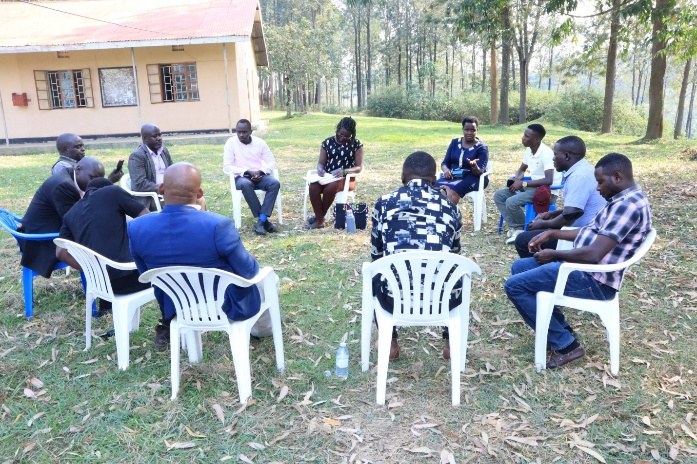
Strengthening Resilient Farming Families Through Agroecology
The Sustainable Family Farm Development Program is JESE’s flagship agroecology initiative that supports smallholder farming households to build resilient livelihoods while restoring the health of their farms and natural resources. Implemented in Kahunge and Busiriba sub-counties of Kamwenge District, the program equips farming families with the knowledge, skills, and opportunities to improve productivity, strengthen food security, increase household incomes, and adapt to climate change.
Recognizing that sustainable agriculture extends beyond increasing yields, the program integrates agroecological farming practices, gender transformation, farmer-led innovation, and evidence-based advocacy to create lasting change at household and community levels.
Our Approach
The programme applies a holistic family farming model that combines:
- Capacity building through farmer training, extension services, and continuous coaching.
- Farmer-led demonstration sites where communities learn by seeing, experimenting, and sharing experiences.
- Participatory Action Research (PAR) that positions farmers as co-researchers to identify challenges, test innovations, and develop practical solutions that fit their local context.
- Gender transformation through the MenEngage approach and Women in Business and Leadership initiatives that promote shared decision-making, equitable access to productive resources, and women’s leadership.
- Evidence-based advocacy that engages local governments and stakeholders to promote policies and investments that support agroecology and sustainable family farming.
More productive and resilient farms
The program has enabled farming households to adopt agroecological practices that improve soil fertility, conserve water, enhance biodiversity, and strengthen resilience to climate variability. Continuous extension support, practical demonstrations, refresher training, and farmer-led research have contributed to consistent improvements in agricultural productivity across the program’s major value chains.
Between program inception and mid-2026, average production increased significantly:
These gains demonstrate the value of combining agroecological farming practices with continuous farmer learning and locally driven innovation.
|
Value Chain |
Baseline |
Mid-2026 |
|
Banana |
50 bunches |
455 bunches |
|
Beans |
144 kg |
471 kg |
|
Coffee |
427 kg |
518 kg |
|
Maize |
572 kg |
1,043 kg |
Improved farm management, higher productivity, and better produce quality have translated into stronger household incomes. Combined with favorable coffee prices, participating households have experienced a steady increase in earnings from their farms.
Average annual household farm income increased from UGX 2.16 million in December 2025 to UGX 2.84 million by June 2026, strengthening families’ ability to invest in education, nutrition, healthcare, and farm development.
The program is helping families transform their farms into sustainable production systems. Farmers are increasingly adopting practices such as mulching, integrated soil fertility management, agroforestry, improved livestock management, and water conservation. These practices are improving soil health, reducing environmental degradation, and enhancing the long-term productivity and resilience of family farms.
The Sustainable Family Farm Development Program promotes gender-equitable and inclusive family farming through the MenEngage approach and Women in Business and Leadership initiatives, fostering shared decision-making and equitable access to productive resources. By mid-2026, all participating households involved women in household decision-making, with women achieving universal access to and ownership of productive resources. The program also recorded significant gains in youth inclusion, with young women’s participation in household decision-making increasing from 49% to 64% and their ownership of productive resources rising from 40% to 59%, while ownership among young men increased from 44% to 60%. These achievements demonstrate that empowering women and youth strengthens household governance, promotes inclusive family farming, and contributes to more resilient and sustainable livelihoods.
One of the program’s defining strengths is its participatory action research approach. Farmers are not simply recipients of agricultural advice; they are innovators and co-creators of solutions. Working alongside JESE technical staff, they identify production challenges, establish learning sites, test promising technologies, and evaluate results before sharing successful practices across their communities.
This collaborative process has produced practical, locally relevant innovations while fostering strong farmer ownership, accelerating the adoption of improved practices, and strengthening communities’ capacity to continuously adapt to emerging agricultural challenges.
As the program enters its final implementation phase, JESE continues to work with farming families, local governments, and development partners to consolidate gains and ensure that the knowledge, systems, and community structures established through the program continue to drive sustainable agricultural transformation beyond 2026. The Sustainable Family Farm Development Program demonstrates that when agroecological farming practices are combined with farmer leadership, gender equality, and evidence-driven innovation, smallholder farming families can build resilient livelihoods while contributing to healthier food systems and thriving rural communities.
Contact us at the Consulting WP office nearest to you or submit a business inquiry online.
Consulting theme is an invaluable partner. Our teams have collaborated to support the growing field of practitioners using collective impact.
